

US Rescues Airman As Iran Ignores Trump Threats
By Reuters | 05 Apr, 2026
The weapons officer from a downed F-15 was rescued as Iran continues to ignore yet another ultimatum and vulgar threats by Trump.
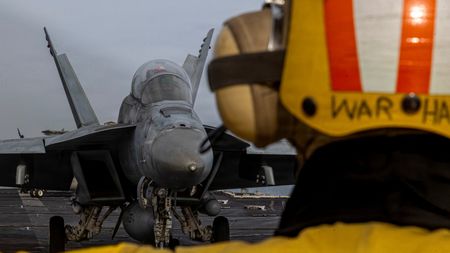
An F/A-18F Super Hornet prepares to launch from the flight deck of the U.S. Navy Nimitz-class aircraft carrier USS Abraham Lincoln at an undisclosed location during the Operation Epic Fury attack on Iran, March 31, 2026. U.S. Navy/Handout via REUTERS/File Photo
U.S. special forces rescued a downed airman in Iran in a complex operation that averted a potential crisis for President Donald Trump, who issued renewed threats to intensify attacks if Tehran did not re-open the Strait of Hormuz.
Trump announced the rescue in the early hours of Sunday in a social media post that described the operation, in a mountainous area of Iran, as "one of the most daring Search and Rescue Operations in U.S. History".
The airman, the weapons officer of an F-15 jet shot down on Friday, was wounded but "will be just fine", Trump said in a message on X posted by Press Secretary Karoline Leavitt. The pilot of the aircraft was rescued on Friday.
In another post, laden with expletives, Trump repeated a demand that Iran open the Strait of Hormuz, the vital conduit for around a fifth of the world's oil and natural gas supply, which has been largely shut down since the start of the war five weeks ago.
"Tuesday will be Power Plant Day, and Bridge Day, all wrapped up in one, in Iran," he said on his Truth Social platform.
"There will be nothing like it!!! Open the Fuckin’ Strait, you crazy bastards, or you’ll be living in Hell - JUST WATCH! Praise be to Allah. President DONALD J. TRUMP"
Adding to the pressure, a senior Israeli defence official said Israel, which attacked a major petrochemicals facility on Saturday, was preparing to attack Iranian energy facilities within the next week, and was awaiting approval from Washington.
However, in an interview with Fox News on Sunday, Trump said Iran was negotiating and he believed a deal could be concluded by Monday.
With the impact from the closure of the Strait on the global economy deepening by the day, the rescue of the U.S. airman removed the risk for Trump of a hostage crisis further souring the mood of an American public already sceptical of the war.
A U.S. official said the operation, which Israel said it had assisted, involved dozens of military aircraft and encountered fierce resistance from Iranian forces.
Iran's military said several U.S. aircraft were destroyed during the operation, including two military transport planes and two Black Hawk helicopters. Footage posted on social media showed burned-out aircraft wreckage, which Reuters verified was in the area.
RESCUE INVOLVED 'DECEPTION CAMPAIGN'
The loss of the F-15 last week as well as an A-10 ground-attack aircraft which came down in a separate incident, underlined the risks still facing U.S. and Israeli aircrew despite Trump's assertions that Iran's air defences have been largely destroyed.
A U.S. official told Reuters U.S. forces had to destroy at least one of the aircraft used in the rescue mission because it had malfunctioned but many details of what occurred in the operation remained unclear.
The Wall Street Journal reported that two specially equipped MC-130Js aircraft used to carry out covert infiltrations and to remove troops from beyond enemy lines were blown up by U.S. forces after malfunctioning.
A senior administration official in Washington said the rescue had involved a CIA deception campaign spreading word inside Iran that U.S. forces had already found the missing airman and were moving him on the ground for exfiltration out of the country.
While the Iranians were confused and uncertain of what was happening, the missing weapons officer was located inside a mountain crevice and rescued, the official said in a statement.
PEACE EFFORTS PROVE FRUITLESS
The war, which opened with U.S. and Israeli air strikes across Iran on Feb. 28, has spread into Lebanon, where Israel has resumed its campaign against the Iranian-backed Hezbollah. Thousands have been killed, mainly in Iran and Lebanon, where a Lebanese soldier was killed on Sunday.
But efforts brokered by Pakistan to bring the two sides to an agreement have so far been fruitless. Iran's Foreign Minister Abbas Araqchi said Tehran demanded a permanent halt to the U.S. and Israeli campaign.
"What we care about are the terms of a conclusive and lasting END to the illegal war that is imposed on us," he said in a message on X.
Iran has so far shown no signs of complying with Trump's demand to re-open Hormuz, despite the heavy damage to its military and civilian infrastructure by weeks of U.S. and Israeli attacks.
Its chokehold over the narrow shipping lane has given it a powerful weapon and it has continued to launch missile and drone attacks against Israel and on U.S. allies in the Gulf which remain highly vulnerable to attacks on key infrastructure including power and water desalination plants.
On Sunday, in response to Israeli attacks on petrochemical sites in Iran, Iran hit petrochemicals plants in Bahrain and Abu Dhabi, where damage was reported after falling debris from an air defence interception ignited three fires at a plant operated by the Borouge group.
The strikes followed similar attacks on oil facilities, a major aluminium plant and petrochemical sites in recent days and the Revolutionary Guards warned that more would follow if civilian targets in Iran were hit.
With oil coming through Hormuz down to a trickle, ministers from OPEC oil-producing countries were due to meet on Sunday. But the blockade of the Strait and the damage to infrastructure meant an immediate boost to oil production was not considered possible.
Earlier Iran also attacked an Israel-affiliated vessel with a drone in the Strait, setting the ship on fire, state media said, citing the commander of the Revolutionary Guards' navy.
(Reporting by Phil Stewart, Idrees Ali and Michael Martina in Washington, Enas Alashray and Hatem Maher in Cairo, Eleanor Whalley and K. Vinaya, Jerusalem bureau and Reuters bureaux worldwide; Writing by Clarence Fernandez and James Mackenzie; Editing by Rod Nickel, Cynthia Osterman and William Mallard)
Articles
- China Ready to Join with Russia to End Mideast Misery
- What Do You Call a President Who Never Learns from His Mistakes?
- Foxconn Q1 Revenue Jumps on Strong Demand for AI Servers
- US Rescues Airman As Iran Ignores Trump Threats
- What's the Best College for Asian Americans?
- Judge Blocks Trump from Forcing Colleges to Provide Race-Related Data
- Telegram's Durov Hails Russian Resistance Against Moscow's VPN Blocks
- Iran Leaves Door Open for Peace Talks, Mocks Trump's Demands
- Iran Claims New Air Defense System Used to Shoot Down US Jet
- The “Kash Patel” Bollywood Video That Got Our Hopes Up