

Warmongering, the Last Refuge of Failing Presidents
By Tom Kagy | 20 Feb, 2026
Saber-rattling is like a baby-rattle for an insecure leader in need of comfort or his political death rattle.
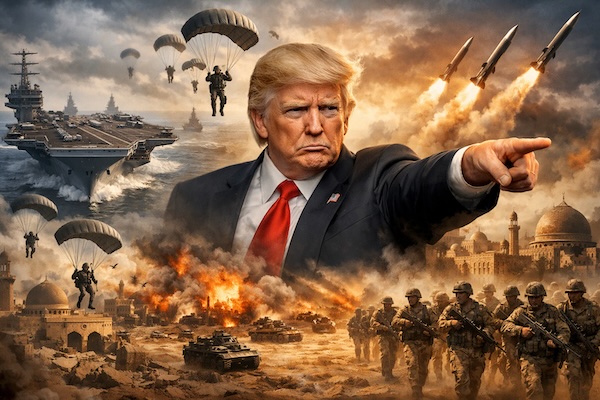
(Image by ChatGPT)
Being President can be a tough gig. One day you’re leader of the free world, the next, your approval ratings are underwater because your signature tariffs have triggered an accelerating economic slump and your mass deportation scheme has provoked cries for your ouster across the land.
When an over-the-top populist agenda gets chewed up by harsh reality, the ego of bad leaders gets bruised, they don't try to correct their errors, they look for a surefire way to silence critics. That often means starting a good, old-fashioned war. If a full-scale invasion is too expensive, a bit of high-stakes saber-rattling usually does the trick.
It’s the ultimate "look over there!" move. When the economy is tanking and the public is angry, failing leaders call the Joint Chiefs. Why? Because it’s much easier to send ships and fighter jets abroad than it is to fix things at home.
The "Rally 'Round the Flag" Trap
Bad leaders instinctively understand the "Rally 'Round the Flag" effect. Even simple-minded leaders knows that when people feel threatened by an outsider, we stop bickering with each other and line up behind the person in charge.
Failing Presidents want reporters hounding them about sex scandals and the price of eggs to shift their focus to troop movements. The opposition party, afraid of looking "unpatriotic," stops blocking legislation and starts wearing flag pins. For a few glorious weeks or months, the President isn't a politician with a 38% approval rating; they are a Commander-in-Chief.
The problem is that this "comfort" is like a baby rattle. It makes a lot of noise, it feels good in the hand, and it keeps the person holding it occupied—but it doesn't actually solve the underlying hunger or pain.
A few examples illustrate what I mean:
James K. Polk and the "Manifest" Distraction
Back in the 1840s James K. Polk was facing a mess. He’d promised a lot and was dealing with a deeply divided country over the issue of slavery and new territories. He needed a win, and he needed it fast.
Polk didn't just stumble into the Mexican-American War; he poked the bear until the bear bit back. By sending troops into disputed territory, he manufactured a "border incident" that allowed him to wrap himself in the flag. It worked—initially. The war expanded the US massively, and for a moment, the domestic squabbles were drowned out by the drums of victory.
But the "fix" was a sham. By grabbing all that new land, he actually accelerated the tensions over slavery that eventually led to the Civil War. He used war to solve a political headache and ended up giving the country a migraine that lasted a century.
Lyndon B. Johnson and the Gulf of Tonkin
Fast forward to 1964. LBJ was a master of domestic policy—The Great Society, civil rights, the war on poverty. But he was also terrified of being seen as "soft" on communism, especially with an election looming and a restless right wing.
When the report came in about a murky, highly questionable encounter between US destroyers and North Vietnamese boats in the Gulf of Tonkin, Johnson didn't wait for a second opinion. He used that "threat" to pivot hard into a war that would eventually swallow his presidency whole. He traded his domestic dreams for a military quagmire because he thought he needed to look tough to maintain control.
It’s the classic insecure leader move: burning down the house because you’re afraid people think you don’t know how to use the fireplace.
Bill Clinton and the "Wag the Dog" Theory
We can't talk about warmongering as a refuge without mentioning 1998. Bill Clinton was staring down the barrel of the Monica Lewinsky scandal and a looming impeachment. The headlines were ugly, personal, and relentless.
Then, suddenly, the US launched cruise missile strikes against sites in Sudan and Afghanistan. The administration claimed they were hitting terrorist infrastructure. Critics, however, pointed out the suspicious timing—the strikes happened just three days after Clinton’s grand jury testimony.
While the threats were real, the timing was a classic case of using the military to change the channel. When the evening news is talking about "Operation Infinite Reach," they aren't talking about stained blue dresses (or incriminating photos and emails). It’s a cynical use of fire and brimstone to provide a smoke screen for personal failure.
Cost of the Rattle
The tragedy of the "baby-rattle" approach to foreign policy is that it’s never the leader who pays the price. The President gets their poll bounce, their "historic" footage of jets taking off from carriers, and a temporary reprieve from their domestic failures.
Meanwhile, the actual cost is measured in lives, debt, and global stability. When a leader uses war to fix their image, they aren't just being "tough"—they’re being lazy. Fixing a broken trade relationships or bringing down inflation is hard, tedious work that requires compromise and intelligence. Firing a missile or sending in special forces is easy (for the President, not the actual troops). It’s the ultimate shortcut for a leader who never had many good ideas in dealing with reality.
Insecurity of the Weak Strongman
Truly successful, secure presidents always try to avoid war. They have the political capital, as well as a sense of personal confidence and self-respect, to negotiate, to wait, and to focus on the boring stuff that actually makes a country better. Warmongering is always a sign of weakness, not strength. It’s the roar of a cornered animal, not the steady gaze of a leader in control.
When we see a leader whose agenda is in tatters suddenly start talking about "national security," "dangerous nations," or the need for "decisive action" in a country we can barely find on a map, let's look past the flag-waving and the dramatic soundtrack and ask, "What's he trying to make us forget?"
Saber-rattling might give comfort to an insecure leader, but for the rest of us, it’s just dangerous and distracting noise. A president who can't lead at home will always try to "rule" abroad, and that never ends well.
© 2026 by Asian Media Group Inc.
Recent Articles
- Italy's Meloni Tells Trump to Focus on His Own Popularity as Row Continues
- Trump Unveils Gifted Qatari 747 As Addition to Air Force One Fleet
- A Warm World Cup Welcome Endears the US to Fans
- China's May Refined Oil Exports Rose from April, Australia Received Agreed Volume
- New Bangladesh Premier to Seek Investments, Jobs in China, Malaysia
- Charles Schwab Working with Cboe to Enter Prediction Market
- Mexico's Love Affair with All Things Korean — Until Thursday's Kickoff
- The Making of a Striking Tiger
- Japan's World Cup Prospects Brighter Than Their Single Group Point Might Suggest
- International Stars in the Red Devils' Lineup Suggests a Deep World Cup Run for S. Korea