

The Transcontinental Railroad Owes a Huge Debt to Chinese Immigrants
By Kelli Luu | 05 Feb, 2026
Take a closer look at the immigrant labor that built America’s first transcontinental railroad and how Chinese workers were left out of the story.
The history of the Transcontinental Railroad is often looked at as a story of American progress, but what’s rarely talked about is who built it and the unequal tale behind it.
The Transcontinental Railroad was a massive 1860s project that would connect the East and the West. It was constructed by two competing companies, Central Pacific Railroad which began in Sacramento, California and Union Pacific Railroad starting in Omaha, Nebraska. It was a race to meet in the middle and the two sides were reliant on two very different labor forces.
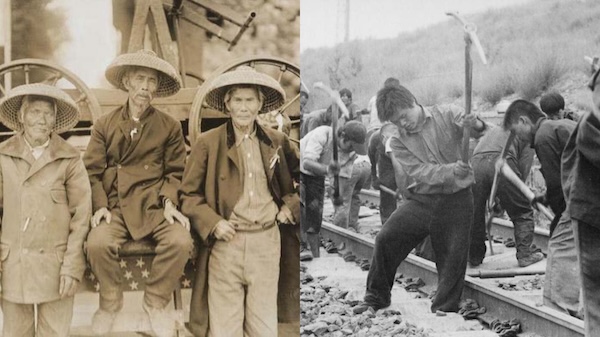
The Central Pacific was dependent on Chinese immigrant workers with an estimated 10,000 to 15,000 Chinese laborers making up 80-90% of the entire workforce. The Union Pacific Railroad employed over 8,000 workers consisting largely of Irish immigrants, formerly enslaved Black men, and Civil War veterans.
This distinction is important because building the western side of the railroad was far more dangerous and strenuous. Those employed by Union Pacific were tasked with much flatter terrain, but still faced harsh environments and extreme labor conditions, being paid $35 a month.
Chinese workers endured the duties of structuring the railroad through the Sierra Nevada mountains where they had to create tunnels through solid granite with black powder blasts and chisels, work on steep cliffs, and survive the brutal avalanches during the winter. For $24-$31 a month, much less than Union Pacific employees, many workers were lowered over cliffs in order to place explosives, making this job one of the most dangerous in the 19th-century.
During this time Chinese workers were also fighting for their rights as they organized an eight day strike in the Sierra Nevada to demand higher wages and better conditions. This was one of the largest labor strikes in the West but unfortunately, it failed after Central Pacific cut off food and other supplies to their camps.
When the two railroad lines finally met in 1869 at Promontory Summit, the Chinese workers were excluded from official photographs and the celebratory ceremony even though they had just helped make the railroad connection possible. This erasure has shaped the way the history of the Transcontinental Railroad has been remembered, completely ignoring the sacrifice and skill of Chinese immigrants that made it possible. The workers later faced discrimination and exclusionary laws including the Chinese Exclusion Act of 1882 which prohibited Chinese workers from immigrating to the United States.
The history of the Transcontinental Railroad is not just an American engineering success, it’s also a story of unequal labor and racial discrimination. The thousands of Chinese immigrants should have never been excluded from the historical records and understanding who built the railroad and what they went through to build it, can give you a more complete account of how important this monumental project truly is.
© 2026 by Asian Media Group Inc.
Recent Articles
- Italy's Meloni Tells Trump to Focus on His Own Popularity as Row Continues
- Trump Unveils Gifted Qatari 747 As Addition to Air Force One Fleet
- A Warm World Cup Welcome Endears the US to Fans
- China's May Refined Oil Exports Rose from April, Australia Received Agreed Volume
- New Bangladesh Premier to Seek Investments, Jobs in China, Malaysia
- Charles Schwab Working with Cboe to Enter Prediction Market
- Mexico's Love Affair with All Things Korean — Until Thursday's Kickoff
- The Making of a Striking Tiger
- Japan's World Cup Prospects Brighter Than Their Single Group Point Might Suggest
- International Stars in the Red Devils' Lineup Suggests a Deep World Cup Run for S. Korea
Asian American Success Stories
- Asian American Polls
- Asian American Parenting
- Personalities
- Identity
- The 130 Most Inspiring Asian Americans of All Time
- 12 Most Brilliant Asian Americans
- Greatest Asian American War Heroes
- Asian American Digital Pioneers
- New Asian American Imagemakers
- Asian American Innovators
- The 20 Most Inspiring Asian Sports Stars
- 5 Most Daring Asian Americans
- Surprising Superstars
- TV’s Hottest Asians
- 100 Greatest Asian American Entrepreneurs