

How SFFA Changed Asian American Enrollment in Leading Universities
By Goldsea Staff | 04 Feb, 2026
The 2023 Supreme Court decision outlawing race-based affirmative action has produced a broad range of changes at Harvard, MIT, Stanford, Berkeley and other Ivies.
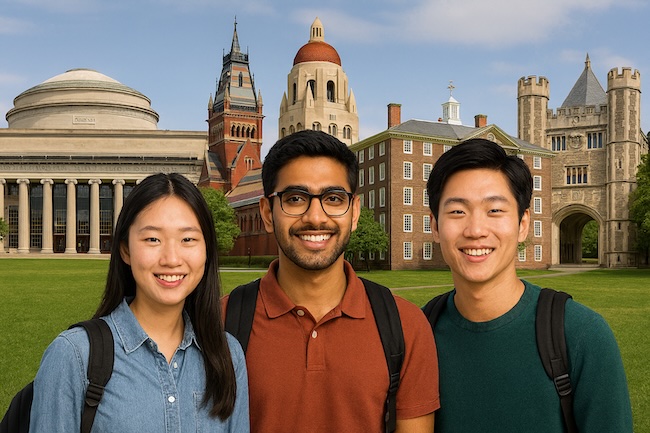
(Image by CoPilot)
Race-based affirmative action was declared unconstitutional by the Supreme Court in 2023 in Students for Fair Admissions v. Harvard (SFFA) and Students for Fair Admissions v. UNC. This forced many leading universities to revise how they assemble their incoming classes. The decision applied to all institutions receiving federal funding, but its effects have been most visible at the nation's most competitive universities.
SFFA had argued that elite universities—particularly Harvard—were artificially limiting the number of Asian American students through subjective criteria and opaque holistic review processes. The Court didn't explicitly endorse that claim, but the ruling effectively dismantled the admissions frameworks at Harvard, as well as all universities that had been using race as a selection criterion.
As the first post‑decision admissions cycles unfolded, analysts, journalists, and university officials scrutinized how Asian American representation changed across the Ivy League and other top institutions.
The results have been uneven. Some universities saw dramatic increases, others experienced modest declines, and still others showed almost no change at all. The variation reflects differences in institutional missions, applicant pools, state laws, and the degree to which race had previously been used as a factor in admissions.
The most dramatic shift occurred at MIT. In the first full admissions cycle after the SFFA ruling, MIT reported that Asian American students made up 47 percent of its incoming class, up from 40 percent the previous year. A 7‑point jump at a school already known for its high Asian enrollment is the largest single‑year increase reported by any elite university in the country. And that jump was maintained for the 2025-26 school year. MIT’s admissions office didn't attribute the rise directly to the Supreme Court decision, but the timing and magnitude of the change made it a focal point in national discussions about the ruling’s impact.
MIT’s surge is especially notable because the institute has long emphasized quantitative metrics and academic preparation more heavily than many Ivy League schools. Its admissions process has historically been less reliant on the kinds of subjective evaluations—such as personal ratings and character assessments—that were central to the SFFA case against Harvard. Even so, the post‑ruling increase suggests that the removal of race as an admissions factor may have amplified existing trends in MIT’s applicant pool, particularly in STEM fields where Asian American students are heavily represented.
Stanford, another elite private university with a strong STEM identity, also reported an increase in Asian American enrollment, though the rise was more modest. Stanford’s most recent class entering in 2025 included the highest share of Asian American students in three years at 44%. Because Stanford allows applicants to select multiple racial identities, its numbers are not directly comparable to MIT’s or the Ivies’, but the direction of change is clear. The steady increase fits within a broader pattern: universities with large STEM applicant pools and less reliance on race‑conscious admissions practices appear to have experienced smoother transitions in the post‑SFFA era.
The Ivy League, by contrast, has shown a more complex and uneven response. Across the eight schools, Asian American enrollment had been rising gradually for more than a decade, moving from the mid‑teens to the high‑teens or low‑twenties as a percentage of incoming classes. This long‑term trend reflected demographic changes, shifting applicant behavior, and the growing academic competitiveness of Asian American students.
Princeton, Columbia and Brown Asian American enrollment continuing their upward trajectories. For the 2024-25 year Princeton reported a 2.2% decline from the 26% in 2023-24, but saw an increase to 27.1% for the 2025-26 year. Columbia has seen steady growth in Asian representation over the past several years, and the post‑ruling bump was consistent with that pattern. Brown’s increase was smaller but still notable, suggesting that the school’s recalibrated admissions process may have modestly shifted the composition of its incoming class.
Other Ivies moved in the opposite direction. Yale and Dartmouth reported declines in Asian American enrollment. The decreases were not dramatic, but they were significant enough to draw attention, especially given the expectation among some observers that Asian representation would rise across the board after the ruling. These declines highlight the degree to which institutional priorities, applicant behavior, and internal policy adjustments can produce divergent outcomes even within a relatively homogenous group of elite universities.
Harvard, the institution at the center of the SFFA case, reported almost no change in Asian American enrollment. Its numbers remained essentially flat, suggesting that the immediate impact of the ruling was limited. Harvard’s stability may reflect several factors: the school’s already high Asian American share, the complexity of its admissions process, and the possibility that the university made internal adjustments to preserve continuity in the composition of its class. It may also indicate that the effects of the ruling will unfold gradually rather than in a single dramatic shift.
The University of Pennsylvania and Cornell have not yet released detailed breakdowns for the most recent cycle, but historically both have tracked closely with broader Ivy League trends. Their long‑term patterns suggest that any changes are likely to be incremental rather than transformative.
Outside the Ivy League, the University of California system provides an important point of comparison. California banned race‑based affirmative action in public university admissions in 1996, nearly three decades before the SFFA ruling. As a result, UC campuses have long operated under a race‑neutral framework. UC Berkeley, the system’s flagship, has maintained Asian American enrollment levels around 40 to 45 percent for years.
Because Berkeley and other UC campuses were already prohibited from considering race, the SFFA decision had no direct effect on their admissions processes. Their stability serves as a reminder that race‑neutral admissions can produce high Asian American representation, especially in large public systems with strong STEM programs and diverse applicant pools.
The University of Michigan offers a similar case study. Michigan has been under a statewide affirmative action ban since 2006. Its Asian American enrollment has hovered in the 15 to 20 percent range, rising slowly over time. Like the UC system, Michigan’s long‑term data shows that race‑neutral admissions do not necessarily produce dramatic year‑to‑year swings. Instead, changes tend to reflect broader demographic and academic trends rather than policy shocks.
Taken together, these examples illustrate that the impact of the SFFA decision varies based on institutional context, historical practices, and the composition of applicant pools. MIT’s dramatic increase stands out precisely because it's an outlier. Most other elite universities have experienced more modest shifts, and some have seen little change at all.
Several factors help explain this variation. First, universities differ in how heavily they previously relied on race as an admissions factor. Institutions that used race more explicitly or more consistently may have had to make more substantial adjustments after the ruling. Second, applicant behavior may have shifted in response to the decision. Some students may have changed their application strategies, believing that certain schools would become more or less accessible in a race‑neutral environment. Third, universities have adopted a range of new practices—such as expanded essay prompts, targeted outreach, and socioeconomic considerations—to maintain diversity without using race directly.
Another important factor is the role of academic interest. Universities with strong STEM identities, like MIT and Berkeley, tend to attract large numbers of Asian American applicants. As a result, their enrollment patterns may be more sensitive to changes in applicant volume or academic preparation than to shifts in admissions policy. By contrast, universities with broader liberal arts missions may experience more complex interactions between applicant behavior, institutional priorities, and the constraints imposed by the SFFA ruling.
It's also worth noting that the first admissions cycle after a major policy change isn't always predictive of long‑term trends. Universities are still adapting to the new legal landscape, and applicants are still learning how to navigate it. Over time, both groups may adjust their strategies in ways that produce different outcomes. For example, universities may refine their essay prompts or outreach efforts, while applicants may recalibrate their expectations about which schools are most accessible.
© 2026 by Asian Media Group Inc.
Recent Articles
- Italy's Meloni Tells Trump to Focus on His Own Popularity as Row Continues
- Trump Unveils Gifted Qatari 747 As Addition to Air Force One Fleet
- A Warm World Cup Welcome Endears the US to Fans
- China's May Refined Oil Exports Rose from April, Australia Received Agreed Volume
- New Bangladesh Premier to Seek Investments, Jobs in China, Malaysia
- Charles Schwab Working with Cboe to Enter Prediction Market
- Mexico's Love Affair with All Things Korean — Until Thursday's Kickoff
- The Making of a Striking Tiger
- Japan's World Cup Prospects Brighter Than Their Single Group Point Might Suggest
- International Stars in the Red Devils' Lineup Suggests a Deep World Cup Run for S. Korea