

GM to Produce Lower-Cost LFP Batteries with LG Chem
By Reuters | 14 Jul, 2025
To lower the cost of EV batteries and make them more durable and cold-resistant, General Motors is shifting production toward lithium-iron-phosphate batteries in its Tennessee plant for use in the Cadillac Lyric.
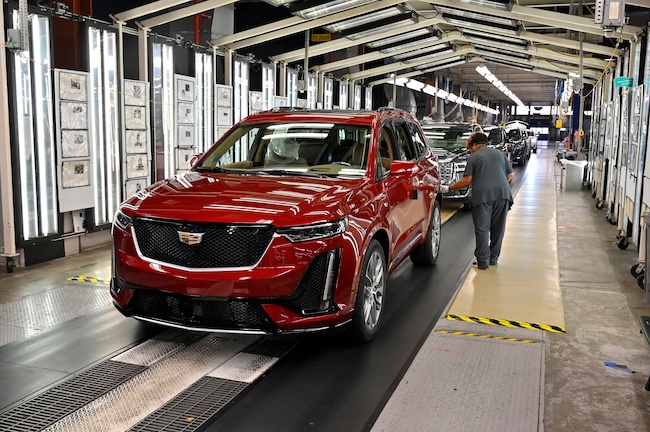
Final inspection is performed as the vehicles are ready to leave the assembly line at the General Motors (GM) manufacturing plant in Spring Hill, Tennessee, U.S. Picture taken August 22, 2019. REUTERS/Harrison McClary/File Photo
General Motors is planning to produce lower-cost battery cells at its joint-venture plant with South Korea's LG Energy Solution in Tennessee.
The Detroit automaker is rolling out production of lithium-iron-phosphate (LFP) batteries, a technology that is gaining popularity at other automakers in the U.S. including at cross-town rival Ford Motor. GM will begin converting battery cell lines at its Spring Hill, Tennessee facility later this year, and commercial production is expected to begin by late 2027, the company said Monday.
GM and other automakers have pulled back some of their goals around electric vehicle production as demand for the models has been weaker-than-anticipated. Still, auto companies are investing billions in future battery technology and EV production facilities, with the expectation that shoppers will eventually make the switch from traditional gasoline vehicles.
GM currently produces nickel-cobalt-manganese-aluminum cells at the factory, and will continue to do so at a plant in Ohio. The cells produced in Tennessee are used for EVs made at the neighboring assembly plant, including the Cadillac Lyriq. The factory employs about 1,300 people, GM said. Workers at the Ultium Cells joint-venture factory earlier this year approved their first contract with the United Auto Workers union.
Ford is planning to produce LFP batteries at a factory in Michigan using technology from Chinese battery giant CATL. The plant, announced in 2023, has drawn scrutiny from some lawmakers for its ties to the Chinese company. It is expected to begin production in 2026.
Both automakers are also working on production of lithium manganese-rich (LMR) chemistries, which are intended to provide drivers with more mileage on their EVs before needing to charge. Concerns around battery range, as well as high vehicle prices, are some of the top barriers keeping customers from buying electric vehicles, auto executives have said.
(Reporting by Nora Eckert in DetroitEditing by Nick Zieminski)
Auto companies are investing billions in future battery technology and EV production facilities, with the expectation that shoppers will eventually make the switch from traditional gasoline vehicles.
Articles
- US Crude Premiums Hits Record Levels as Asia, Europe Compete for Supply
- China Targets Taiwan's Chip Prowess to Avoid 'Containment' Says Taipei
- Nvidia's Buy of Main Supercomputer Software Raises AI Chip Neutrality Concerns
- SpaceX Plans Early June Pre-IPO Roadshow
- OpenAI's Jason Kwon Asks State AGs to Probe Musk's 'Anti-Competitive Behavior’
- Broadcom Scores Long-Term Deal to Develop Custom AI Chips for Google
- Samsung Q1 Profits Surge 8-Fold on AI Demand
- Judge Tana Lin Dismisses Lead-Scare Class Action Against Stanley Tumblers
- Fed Governors See Urgent Inflation Warning Signs
- Trump Continues Uncontrolled Trash Talking