

What's Alexandr Wang Doing to Scale Up Meta's Superintelligence Push?
By JL Zhang | 02 Jun, 2026
What Mark Zuckerberg got for the $14-billion-plus he invested to snatch the Scale AI founder from his company to lead Meta's AI efforts.
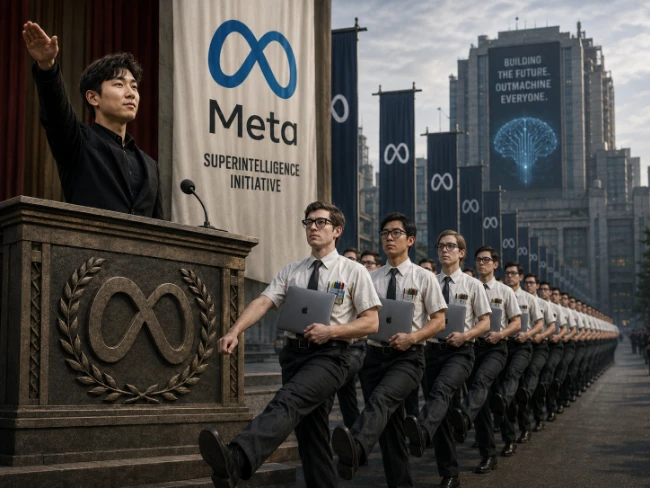
These days people ask two questions about Alexandr Wang.
What happened to the final "e" of his first name?
Secondly, what's he doing to justify the roughly $14 billion payday Meta handed over to bring him into Mark Zuckerberg's increasingly frantic race toward superintelligence?
The answer to the first question is probably less interesting than the answer to the second. Somewhere along the way, the Los Alamos-born founder of Scale AI decided that Alexandr looked cleaner, sharper and more memorable than Alexander. In Silicon Valley, even a missing vowel can feel like a branding strategy.
The second question is much more consequential because Zuckerberg didn't just spend over $14 billion to acquire a large stake in Scale AI. He spent that money largely to acquire Wang himself. Meta's investment gave it a 49% stake in Scale AI while bringing Wang inside the company to help lead its new superintelligence effort.
That's an astonishing amount of money to spend on a 28-year-old founder.
Unless, of course, Zuckerberg believes Wang isn't merely another AI executive. Unless he believes Wang is the guy who can organize the industrial machinery needed to build the next generation of artificial intelligence.
That's probably the real bet.
The Builder, Not The Scientist
One of the more interesting things about Wang is that he's not primarily known as a breakthrough AI researcher.
He didn't invent the transformer architecture.
He didn't publish the foundational papers behind large language models.
He isn't viewed in the same category as people like Ilya Sutskever, Geoffrey Hinton, Demis Hassabis or Yann LeCun.
What Wang built instead was something that turned out to be almost as important: infrastructure.
Scale AI became one of the crucial suppliers of training data, data labeling, model evaluation and human-feedback systems that helped power the modern AI boom. Major AI companies relied on Scale's services to improve and validate increasingly sophisticated models.
That may sound boring compared with inventing artificial general intelligence.
In fact, it may be one of the biggest lessons of the entire AI era.
Everybody likes talking about models.
Very few people like talking about the massive industrial operation required to feed those models.
Wang built that operation.
And Zuckerberg appears to believe that's exactly the skill Meta needs right now.
Meta's Real Problem Isn't GPUs
The popular narrative says Meta is trying to catch OpenAI. Or Google. Or Anthropic. Or all three.
There's some truth to that.
Despite spending tens of billions on AI infrastructure, Meta has struggled to convince investors and researchers that it has established a clear lead in frontier AI development. Reports suggest Zuckerberg became increasingly dissatisfied with the performance and reception of Llama 4 relative to expectations.
But Meta's challenge may not actually be a shortage of computing power.
The company can buy GPUs. It can build data centers. It can spend more money than almost anyone on Earth.
The harder problem is organizational.
Building frontier AI increasingly resembles running a gigantic wartime industrial system. Thousands of researchers. Thousands of engineers. Massive training runs. Massive data pipelines. Massive evaluation systems. Massive infrastructure deployment.
And increasingly, massive coordination problems.
This is where Wang's experience becomes interesting.
At Scale AI he wasn't simply building software.
He was coordinating enormous networks of contractors, experts, customers, governments, defense agencies and AI companies.
That's a different skill set from writing brilliant research papers.
It's the skill set required to scale an entire ecosystem.
The Human Data Bottleneck
One reason Wang became valuable is that AI development is running into a surprisingly old-fashioned constraint. Humans.
As AI systems become smarter, the quality of training data becomes increasingly important.
The internet has already been largely consumed. The easy data has already been harvested.
Now frontier labs increasingly need highly specialized information generated by experts: doctors, scientists, lawyers, engineers, researchers.
The next gains in AI may depend less on finding more data and more on finding better data.
Scale AI positioned itself directly in the middle of that challenge.
The company became known for helping create and evaluate the increasingly sophisticated datasets required for advanced reasoning models. That's a capability Meta desperately wants.
If AI is becoming a contest over who can create the highest-quality feedback loops, Wang may have one of the most practical understandings of that process anywhere in the industry.
Building A Talent Magnet
The most important thing Wang may be doing isn't building models. It's recruiting.
The AI race increasingly resembles professional sports. Except instead of paying $50 million for a superstar shortstop, companies are offering compensation packages worth hundreds of millions of dollars to elite researchers.
Reports indicate Zuckerberg has personally become deeply involved in recruiting efforts for Meta's superintelligence team. Wang is expected to help lead a roughly 50-person elite group focused on achieving advanced AI capabilities. That makes sense.
One of Wang's greatest strengths has always been networking. He built relationships across Silicon Valley, Washington, the defense establishment and the AI community while still in his twenties. Researchers may not join Meta simply because it offers large compensation packages. But they may join if they believe Meta has assembled a team capable of winning. Wang's job is partly to create that belief.
The Geopolitical Dimension
There's another reason Zuckerberg may have wanted Wang. The AI race is increasingly becoming a geopolitical contest.
Wang has been unusually vocal about competition between the United States and China in artificial intelligence. He has argued that America must maintain leadership in AI and has repeatedly framed the technology as a strategic national priority. That worldview aligns neatly with a broader shift happening throughout the industry.
AI is no longer viewed merely as a technology business. It's becoming national infrastructure: military infrastructure, economic infrastructure, political infrastructure.
The companies building frontier AI increasingly operate as though they're participants in a strategic competition between nations. Wang understands that language.
More importantly, he understands how to communicate it to policymakers.
That may become increasingly valuable as governments become more involved in regulating and supporting AI development.
The Sam Altman Parallel
One reason Zuckerberg may find Wang appealing is that he resembles Sam Altman in a surprising way. Neither became famous primarily because of groundbreaking technical research. Both became famous because they could build organizations. They could raise money. They could recruit talent. They could create alliances. They could convince smart people to work together toward ambitious goals.
The AI industry often celebrates researchers. But history suggests transformational industries frequently end up being dominated by organizers. Thomas Edison was an organizer. Henry Ford was an organizer. Steve Jobs was an organizer.
The ability to coordinate thousands of talented people toward a common objective can be more valuable than being the smartest individual in the room.
Wang appears to understand that instinctively.
Can He Actually Deliver Superintelligence?
Of course, none of this guarantees success. Meta's investment is ultimately a gigantic wager. Nobody actually knows how to build superintelligence. Nobody even agrees on exactly what it means. The term itself remains partly technical and partly marketing.
Even the leading AI labs disagree about timelines.
Some believe human-level AI could arrive within a few years. Others believe it remains decades away. Still others think current approaches may hit fundamental limitations before reaching truly general intelligence.
So Wang's mission is arguably impossible. Or at least impossible to define precisely.
But Zuckerberg isn't paying him to solve every scientific problem personally.
He's paying him to maximize Meta's chances of solving them—and perhaps a more realistic one.
The Real Asset Zuckerberg Bought
In the end, Meta didn't spend over $14 billion because Alexandr Wang possesses some secret equation for creating artificial superintelligence. If he had that, the company would probably have paid even more.
What Zuckerberg bought was something potentially just as valuable: execution, coordination, recruiting, infrastructure, data, relationships, operational intensity.
The ability to take a giant organization and align it toward a single objective. That was the real product Scale AI was selling all along, not data labels, model evaluations, or human feedback.
Those were merely the visible outputs.
The deeper product was organizational capability.
And in a world where every major tech company is trying to build the most complicated technology humans have ever attempted, organizational capability may be the rarest resource of all.
So what happened to the final "e" in Alexandr?
Probably nothing too mysterious.
But the second question may determine the future of Meta because Zuckerberg just placed one of the largest talent bets in Silicon Valley history.
Now everybody gets to find out whether Alexandr Wang can scale something even bigger than Scale AI.
Recent Articles
- Huang Anoints Marvell 'Next Trillion-Dollar Company'
- China Owns More Than 11,000 German-Developed Patents
- UN Warns World to Prepare for Extreme El Niño Heat Risk
- SK Hynix Plans to Double Wafer Capacity in Next Five Years
- Robot Patrol Dogs Coming to Taiwan's South China Sea Islands
- Futility of US Efforts to Ban AI Chip Exports to China Noted by Arm Holdings CEO
- China's Carmakers Keep Expanding Europe Footprint
- Amazon's Ring Sued over Facial Recognition Feature
- Tesla Extends Growth Surge of Chinese-Made EVs
- Sanjay Mehrotra's Chat with Jensen Huang Triggered Frugal Micron's Surge to $1 Trillion Club