

US Budget Deficit Keeps Growing Under Trump Policies
By Reuters | 11 Feb, 2026
The anticipated $1.853 trillion fiscal 2026 budget deficit reflects slower economic growth under Trump tariffs and deportations, requiring more borrowing to fund the federal government.
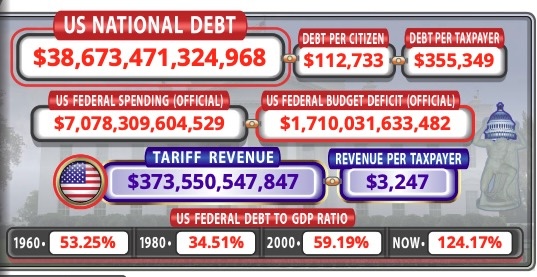
The UD Debt Clock as of February 11 at 807 a.m. PST. (Screenshot of USDebtClock.org homepage)
The U.S. budget deficit will grow slightly in fiscal 2026 to $1.853 trillion, the Congressional Budget Office forecast on Wednesday, showing that on balance, President Donald Trump's economic policies are worsening the country's fiscal picture amid low economic growth.
The CBO said that the deficit for fiscal 2026 will be about 5.8% of GDP, about where it was in fiscal 2025, with a deficit of $1.775 trillion.
But the U.S. deficit-to-GDP ratio will average 6.1% over the next decade, reaching 6.7% in fiscal 2036 - far above U.S. Treasury Secretary Scott Bessent's goal to shrink it to around 3% of economic output.
A major difference is that the CBO forecasts rely on significantly lower economic growth projections than the Trump administration, pegging 2026 real GDP growth at 2.2%, fading to an average of about 1.8% for the rest of the decade. Trump administration officials have said in recent days that first- quarter 2026 growth could top 6% due to rising investments in factories and artificial intelligence data centers.
The fiscal 2026 deficit is about $100 billion or 8% more in CBO's current projections than it was in the agency's January 2025 projections, and the cumulative deficit over the 2026–2035 period is $1.4 trillion, or 6% greater.
Trump's "One Big Beautiful Bill" that extended 2017 tax cuts and slashed outlays on social programs such as Medicaid, will boost consumer spending and private investment this year, CBO said. That legislation will add $4.7 trillion to U.S. deficits over the 10-year budget window, while reduced immigration will add another $500 billion, according to the forecasts.
Added revenue from Trump's tariffs will reduce deficits by about $3 trillion, including economic effects and lower debt payments, CBO said.
The impact of an expected productivity boost from artificial intelligence, a linchpin of administration demands for lower interest rates adopted as well by Fed Chair nominee Kevin Warsh, is estimated at a nominal 10 basis points per year of additional economic output in the CBO report.
Interest rates on 10-year Treasury notes remain roughly where they are now or a little higher, a blow to Trump hopes for cheaper consumer borrowing costs, with the Federal Reserve seen making only a single quarter-point rate cut this year, even with Warsh potentially leading the central bank by June.
(Reporting by David Lawder and Richard Cowan; Additional reporting by Howard Schneider; Editing by Andrea Ricci)
© 2026 by Asian Media Group Inc.
Recent Articles
- Danone-Chobani Yoghurt Protein War Underscores GLP-1 Impact
- Italy's Meloni Tells Trump to Focus on His Own Popularity as Row Continues
- Trump Unveils Gifted Qatari 747 As Addition to Air Force One Fleet
- A Warm World Cup Welcome Endears the US to Fans
- China's May Refined Oil Exports Rose from April, Australia Received Agreed Volume
- New Bangladesh Premier to Seek Investments, Jobs in China, Malaysia
- Charles Schwab Working with Cboe to Enter Prediction Market
- Mexico's Love Affair with All Things Korean — Until Thursday's Kickoff
- The Making of a Striking Tiger
- Japan's World Cup Prospects Brighter Than Their Single Group Point Might Suggest