

Nearly Half of Americans See Trade Deficit As Emergency
By Reuters | 04 Nov, 2025
A new poll suggests many Americans share Trumpian simplistic views about the trade deficit and about how free trade powers global peace and prosperity.
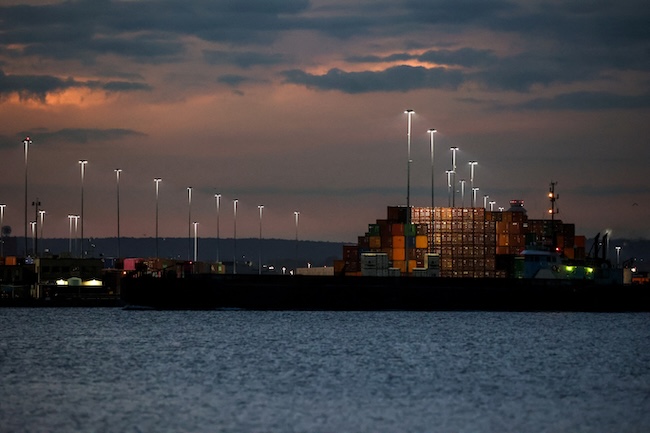
Shipping containers are stacked at the Port Authority of New York and New Jersey in, Newark, New Jersey, U.S., September 30, 2024. REUTERS/Caitlin Ochs
About half of Americans view the large U.S. trade deficit with other countries as an economic emergency, according to a poll released on Tuesday, a day before the Supreme Court is due to consider the legality of sweeping tariffs imposed by President Donald Trump under a law meant for emergencies.
The poll, commissioned by the Alliance for American Manufacturing, found that 47% of respondents view the persistently large U.S. trade deficit as an emergency.
This sentiment was shared across party lines, according to the poll, with 47% of Democrats and 57% of Republicans among the respondents agreeing.
The policy group led by the United Steelworkers union and domestic manufacturers said 40% of the 2,202 adults surveyed believed that trade deficits eroded the U.S. economy and weakened national security. In contrast, 20% saw trade deficits as a sign of economic strength, with strong demand promoting global trade.
The remaining 40% believed neither characterization was correct, or did not know enough to answer, the group said.
The poll, conducted by Morning Consult in mid-October, has a margin of error of plus or minus 2 percentage points.
The Supreme Court will hear oral arguments on Wednesday about the legality of tariffs imposed by Trump on nearly every country, after a lower court ruled that he had overstepped his authority in imposing most of his tariffs under the 1977 International Emergency Economic Powers Act, or IEEPA.
Trump is the first president to invoke the statute to impose tariffs, arguing that a $1.2 trillion U.S. goods trade deficit in 2024 constituted a national emergency.
The IEEPA gave Trump the fastest path to imposing tariffs on goods imported from countries to address trade deficits, as well as separate tariffs as economic leverage on China, Canada and Mexico to curb the trafficking of fentanyl and illicit drugs into the U.S.
U.S. Treasury Secretary Scott Bessent said he expects the Supreme Court to uphold the IEEPA-based tariffs. But if it strikes down the tariffs, Bessent said in an interview, the administration will simply switch to other tariff authorities, including Section 122 of the Trade Act of 1974, which allows broad 15% tariffs for 150 days to calm trade imbalances.
(Reporting by Andrea Shalal; Editing by Himani Sarkar)
© 2025 by Asian Media Group Inc.
Recent Articles
- Samurai Blue Sweep Aside Tunisia, Japan Fans Sweep Monterrey Stadium
- Lebanon Fighting Threatens Switzerland Negotiations
- Danone-Chobani Yoghurt Protein War Underscores GLP-1 Impact
- Italy's Meloni Tells Trump to Focus on His Own Popularity as Row Continues
- Trump Unveils Gifted Qatari 747 As Addition to Air Force One Fleet
- A Warm World Cup Welcome Endears the US to Fans
- China's May Refined Oil Exports Rose from April, Australia Received Agreed Volume
- New Bangladesh Premier to Seek Investments, Jobs in China, Malaysia
- Charles Schwab Working with Cboe to Enter Prediction Market
- Mexico's Love Affair with All Things Korean — Until Thursday's Kickoff