

GoldSea Votes: An Asian Governor in Maine...and Oklahoma?
By J. J. Ghosh | 10 Jun, 2026
Shah leads the Maine primary. Munson is running in Oklahoma. 2026 has more AAPI gubernatorial candidates than any cycle in a decade.
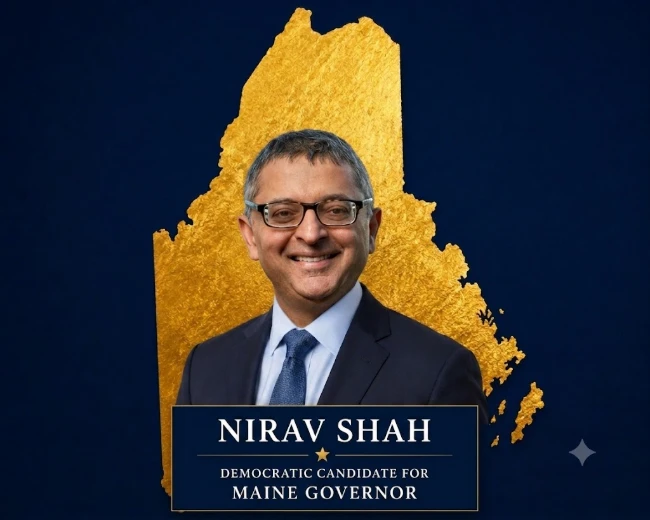
The results from last night’s Maine Democratic gubernatorial primary are, as of this writing, still being counted.
That’s not a glitch. It’s a feature. Maine uses ranked-choice voting, meaning when no candidate clears 50% — which is what happened last night in a five-way Democratic primary — low-performing candidates are eliminated, their votes reallocated to second choices, and the process repeats until someone reaches a majority. That process can take days.
What we do know, with roughly half the votes counted as of Tuesday night, is that Nirav Shah is the frontrunner.
Shah, an Indian American, had about 27% of the vote, ahead of former Maine House Speaker Hannah Pingree at 23%, former Maine Senate President Troy Jackson at 22%, and Secretary of State Shenna Bellows at 21%. Green energy entrepreneur Angus King III appeared headed for a distant fifth-place finish.
“I stand here before you as the clear frontrunner in the Democratic race,” Shah told supporters at his campaign event at Wild Oats Bakery & Café in Brunswick.
The complicating factor is the alliance his opponents formed against him.
Cyndi Munson is running to be Oklahoma's Democratic gubernatorial nominee.webp)
Bellows, Jackson and Pingree vowed to rank one another above Shah in the election — a coordinated effort that, in a ranked-choice system like Maine’s, could prove decisive as second-choice votes are redistributed. Bernie Sanders endorsed Jackson. Outgoing Governor Janet Mills and horror novelist Stephen King backed Pingree. The establishment of the Maine Democratic Party has effectively decided that it would prefer almost anyone to Nirav Shah.
Which makes what Shah has accomplished so far all the more remarkable.
Nirav Shah
The son of Gujarati Indian parents who immigrated to the United States in the 1970s, Shah grew up in Wisconsin in a family that blended Indian and American traditions. His father worked as a physician, and his mother was a preschool educator — instilling in him a lifelong belief in education, service, and community.
Shah was born and raised in a small, rural town of 5,000 people in northern Wisconsin. He attended public schools until going to medical and law school at the University of Chicago. After nearly a decade as a healthcare lawyer, Shah wanted to make a greater impact on public health.
He led the Illinois Department of Public Health, where he worked across the aisle to address the opioid crisis, maternal mortality, and childhood lead poisoning. In 2019, Governor Janet Mills appointed him to lead the Maine CDC.
What happened next made him a household name in the state.
As the threat of COVID-19 emerged, Shah was prepared, taking early action to protect Mainers. In early 2020, Shah secured personal protective equipment for healthcare workers and worked with a Maine company to significantly expand the state’s capacity to perform testing, which ultimately saved lives. Later, Maine’s vaccine rollout became a model for the nation, achieving among the fastest and highest vaccination rates of any state.
He subsequently became Principal Deputy Director of the US CDC — the number two official in the nation’s top public health agency — before returning to Maine to run for governor.
“My parents came to this country with little more than hope and determination,” Shah said. “Maine gave us a home and a future. Now, I want to give back by helping every Mainer — no matter where they come from — have that same opportunity.”
One genuine vulnerability in his profile: while a household name, Shah would have less time in Maine than anyone elected governor in the modern era.
He came to the state in 2019, spent nearly two years based in Atlanta at the US CDC, and returned to run for governor. His opponents have used this to argue he is more of a national figure than a Maine one. Shah has countered that he and his wife chose Maine as their permanent home — and that his record of service to the state during its most difficult public health crisis speaks for itself.
Maine’s Voting History
Maine is, by any reasonable measure, a favorable state for a Democrat to run statewide in 2026.
Maine has voted for every Democratic presidential nominee since 1992, and Kamala Harris defeated Donald Trump by approximately seven percentage points in the 2024 presidential election. The anti-Trump environment that has defined this cycle is particularly pronounced here.
But there is one wrinkle in Maine’s political history that Shah’s campaign cannot ignore. Maine has not elected consecutive governors from the same party since 1952, when Republican Burton M. Cross succeeded Republican Frederick G. Payne. Democrat Janet Mills has held the governorship for two terms. If history holds, Maine is due for a Republican.
The Republican nominee is expected to be Bobby Charles, a former George W. Bush administration official who has led in GOP primary polling. He is a credible candidate in a state that, whatever its recent presidential preferences, has a long history of electing Republican governors.
The general election is therefore genuinely competitive. Shah, if he wins the Democratic nomination, would be running against historical pattern in a state where the winds are otherwise at Democrats’ backs.
Whether the 2026 political environment is strong enough to break a 74-year streak of gubernatorial party alternation is the central question of this race.
The Bigger Picture
If Nirav Shah wins in November, he will make history — but to understand exactly what kind of history, it helps to know the full AAPI gubernatorial record.
Hawaii is its own category entirely. The state has had AAPI governors for most of its existence since statehood in 1959. George Ariyoshi, Japanese American, served from 1974 to 1986 — making him the first AAPI governor in American history, a fact that often gets overlooked. John Waihee, Native Hawaiian, served from 1986 to 1994. Benjamin Cayetano, Filipino American, served from 1994 to 2002 — the first Filipino American governor in US history. David Ige, Japanese American, served from 2014 to 2022. In Hawaii, AAPI governors have been the norm rather than the exception.
Outside of Hawaii, the list is remarkably short. Gary Locke was elected governor of Washington State in 1997 — the first Chinese American governor in US history and the first AAPI governor of a mainland state. Bobby Jindal, of Indian descent, served as governor of Louisiana from 2008 to 2016. Nikki Haley, of Indian Sikh descent, served as governor of South Carolina from 2011 to 2017. That’s it. Three AAPI governors of mainland states across the entire history of the United States.
No AAPI governor is currently serving anywhere in the country. There has not been one since Ige left office in 2022.
Shah would be the first Indian American governor since Jindal. He would be the first AAPI governor of a majority-white, non-Southern state since Locke. And he would be, by a significant margin, the first AAPI governor elected on the strength of a public health record rather than a political machine.
He is not the only AAPI running for governor this cycle.
In Oklahoma, Korean American Cyndi Munson — the Democratic leader in the Oklahoma House of Representatives, the daughter of a Vietnam War veteran and a South Korean immigrant — is also on the ballot. Her platform centers on education funding, expanded healthcare access, and restoring DEI programs. She was first elected to the Oklahoma House in 2015 as the first Asian American woman in the state Legislature, and if she wins in November she would be the first woman of color to serve as Oklahoma's governor.
Let's be honest about her chances: slim. Oklahoma has been under Republican control for nearly two decades, Donald Trump won the state by 33 points in 2024, and no Democrat has won a statewide race there in years. Munson is running a long-shot campaign in deeply hostile territory, and she almost certainly knows it.
But there is value in running anyway. Munson's candidacy puts an AAPI face on a Democratic Party that is still building its presence in red states, gives Oklahoma's small but growing AAPI community a candidate to rally around, and adds her name to a list of historic firsts that will matter to the next generation of Korean American women who want to run for office somewhere they're not supposed to win.
Shah, by contrast, is running in a race that is genuinely competitive. Maine is winnable. The frontrunner status is real. The history he could make is not symbolic — it is the actual governorship of an actual state.
Together they represent the most active AAPI presence in gubernatorial politics since Jindal and Haley served simultaneously over a decade ago. One is fighting for history against the odds. The other is fighting for history with a real shot at getting there.
Shah already leads his. The ranked-choice runoff will tell us whether the Maine Democratic establishment’s anti-Shah alliance was enough to stop him — or whether the frontrunner holds on.
The votes are still being counted. So is history.
© 2026 by Asian Media Group Inc.
The establishment of the Maine Democratic Party has effectively decided that it would prefer almost anyone to Nirav Shah. Which makes what Shah has accomplished so far all the more remarkable.
Recent Articles
- AI Injects Weakness into SpaceX's Ambitious IPO Plans
- Few Americans Love Trump's White House Cage Match Plan
- Google in Talks with Samsung to Make Part of Next-Gen Chip
- Nike's World Cup Play: Take on Adidas and Revitalize the Brand
- India Demands End to US Attacks on Ships After Three Sailors Killed
- SpaceX IPO Draws More Than $70 Billion in Retail Orders
- Ukraine's Drone Commander Aims to Cut Crimea off from Russia
- Anthropic and OpenAI Engaged in Epic Battle for the Future of AI
- Trump Voices Another Territorial Ambition: Iran's Kharg Island Oil Hub
- Bill Gates Testifies Epstein Pressured Him with Knowledge of His Affairs