

Don Scored 2 Huge Wins with His Iran Adventure
By Tom Kagy | 02 Jun, 2026
It didn't do much to stop Iran's nuclear program and missiles but it did stop news stories about Epstein and gave his oil industry donors a $60-billion profit bonus.
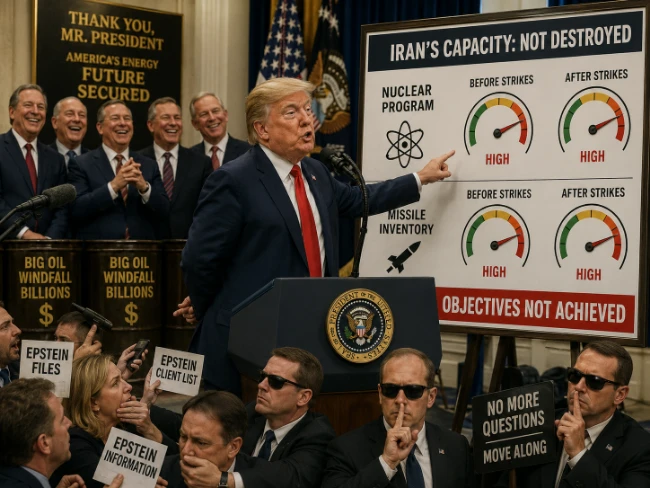
When Donald Trump ordered strikes on Iran's nuclear facilities in June 2025, and then expanded into a full-blown war on February 28, 2026, the official story was simple: Iran was a nuclear threat, America had to act, and the president was just doing what needed to be done.
"Completely and totally obliterated," Trump declared on Truth Social, describing the destruction of Iran's enrichment sites at Fordow, Natanz, and Isfahan. Except it wasn't obliterated. Not even close.
A leaked Defense Intelligence Agency report quietly contradicted the White House's triumphant framing, concluding that the sites were damaged but not destroyed, and that Iran's nuclear program had been set back by a matter of months, not years.
Israeli intelligence reached a similar conclusion. The IAEA called the damage "enormous" -- but enormous and permanent are two very different words. Iran still had its nuclear scientists. It still had its knowledge. And crucially, it still had around 440 kilograms of uranium already enriched to 60 percent U-235 sitting in stockpiles that the bombs never touched.
So the stated objective of the war -- eliminating Iran's nuclear program -- wasn't achieved. The Arms Control Association, not exactly a radical outfit, put it bluntly: military force cannot eliminate Tehran's proliferation risk. At the end of the conflict, Iran will retain the nuclear expertise and key materials necessary for building a bomb.
In fact, arms control experts warned the war was likely to make things worse in the long run, convincing other nations that diplomacy is worthless and that the only real security comes from getting nuclear weapons before America decides to pay you a visit.
So what did the war actually accomplish? Two things, and they're doozies.
Objective One: Make the Epstein Stuff Go Away
Let's rewind to early 2026. Congress had passed the Epstein Files Transparency Act with a staggering 427-to-1 vote. The Senate passed it unanimously. Trump signed it. The Justice Department had released over three million documents by January 30, 2026. Flight logs, communications, photos, references to powerful names across politics, finance, entertainment, and beyond. It was a five-alarm scandal in slow motion, and the fuse was burning closer every day.
Then, on February 28, 2026 -- less than a month after that document dump -- the United States and Israel launched joint strikes on Iran, assassinating Supreme Leader Ali Khamenei and kicking off a conflict that would dominate every front page, every cable news chyron, and every dinner table conversation for months.
The timing, as one analysis put it, was almost too perfect to be coincidental. Independent analysts tracking Google Trends data documented a measurable collapse in public interest in the Epstein files following the start of military operations.
One week you're reading about who flew where on what private jet. The next week you're watching oil tankers getting blockaded in the Strait of Hormuz. It's hard to hold two enormous stories in your head at the same time, and whoever understood that had to have been pleased with the result.
Activists in Washington, DC, weren't buying the official framing. A guerrilla projection group lit up a Metro bridge near I-395 with a six-panel slideshow reminding commuters that "The files aren't in Iran." Hosts on The View asked former Chicago Mayor Rahm Emanuel point-blank whether Trump started the war to distract from Epstein.
Jimmy Kimmel, never one to miss a layup, called it a "weapons of mass distraction" strategy, gleefully playing old clips of Trump himself condemning any president who would consider going to war with Iran.
The White House, for its part, maintained that the Epstein files had been released -- true enough, if you ignore the hundreds of blacked-out pages and the DOJ's acknowledged failure to fully comply with the law. Attorney General Pam Bondi had been making a big show of inviting pro-Trump influencers to the White House to receive binders labeled "The Epstein Files: Phase 1," while extensive redactions kept the most explosive allegations buried. The war gave that whole slow-drip release strategy the best possible cover it could have hoped for.
Objective Two: Deliver an Insane Windfall to the Oil Industry
Here's where we need to talk about money, specifically about the nearly $100 million that Big Oil spent to get Trump elected in 2024.
Going into 2026, the oil industry was not having a great time. Global demand growth was slowing. Electric vehicles were eating into consumption. Prices had sagged to around $58 per barrel in January, down from the $70s the year before. Most market analysts expected prices to stay flat for a year and a half. Oil companies were cutting dividends and scaling back share buyback programs, bracing for a lean year. The people who had bet big on Trump were looking at shrinking returns.
Then came the war.
The moment fighting started and Iran began threatening to close the Strait of Hormuz -- the narrow waterway through which roughly 20 percent of the world's oil consumption typically flows -- energy markets went haywire. West Texas Intermediate crude posted its biggest weekly gain in futures trading history, dating back to 1983, surging about 35 percent in a single week. Oil blasted past $100 a barrel, then $110, then $114. Goldman Sachs estimated it could hit $150.
Trump called the spike "a very small price to pay for safety and peace." Only fools would think differently, he added, in case you missed the condescension.
It's estimated that US oil companies stood to gain a windfall of $60 billion for the year if crude prices maintained those levels. The $100 million Big Oil spent getting Trump into the White House was looking like the investment of the century. Meanwhile, American consumers were looking at an 80 percent chance of hitting $4 per gallon at the pump within a month, and Energy Secretary Chris Wright was letting people know they'd be feeling pain "for weeks." The same administration that campaigned on bringing down energy costs had launched a war that detonated them.
US LNG exporters got in on the windfall too. Because global LNG markets are interconnected, and because Qatari supplies were suddenly disrupted, American natural gas prices spiked as well. LNG exporter stock prices jumped. The oil and gas industry, which had been staring down a rough year, was now looking at a historic profit bonanza -- all funded, in a roundabout way, by the geopolitical chaos the administration had just deliberately created.
The Final Scorecard
Experts across the political spectrum agreed Trump's Iran strikes set Iran back at most a couple of years, and possibly far less, while doing nothing to eliminate its existing uranium stockpiles or the engineers who know how to use them. The Union of Concerned Scientists pointed out that the war actually increased the long-term danger of nuclear proliferation, because other governments will now look at the whole episode and decide that diplomacy is a trap and nukes are the only real deterrent.
What Trump did achieve, quite successfully, was drowning out the Epstein coverage at its most dangerous moment, right when three million documents had just hit the public domain and journalists were starting to connect some very uncomfortable dots. And he delivered a staggering financial reward to the fossil fuel donors who bankrolled his political operation, at the precise moment their industry was bracing for a painful year.
The numbers tell a pretty clear story about who benefited, and who paid the price.
Recent Articles
- US Manufacturing Surge in April Based Entirely on Soaring Aircraft Orders
- AI 'Chipflation' Spreading from Data Centers to Wider Economy
- Targeted Drugs Let More Live with Cancer
- GLP-1 Drugs May Have a Beneficial Effect Across Many Types of Cancer
- Trump Confirms He Called Netanyahu Crazy in Phone Call
- Macy's Raises Annual Forecasts as Luxury Focus Draws Affluent Shoppers
- US Service Sector Growth Picks up in May Despite Higher Prices for Inputs
- US Private Payrolls Rise Broadly in May
- The 4th Time May Be a Charm for the 'New' Keiko Fujimori
- Global Smartphone Market Faces Record Annual Decline as Chip Crunch Worsens