

China Factory Output Shrinks in September
By Reuters | 29 Sep, 2025
Slumping domestic demand and US tariffs result in a sixth straight month of decline in manufacturing output.
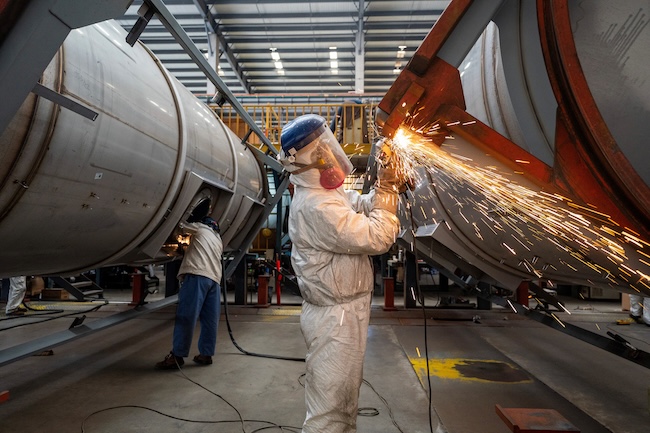
Workers work on a production line, manufacturing tank containers at a factory in Nantong, Jiangsu province, China April 7, 2025. cnsphoto via REUTERS/File Photo
China's factory activity probably shrank for a sixth straight month in September, keeping alive calls for more stimulus in the world's second-largest economy to fend off a sharp slowdown as a U.S. trade deal remains distant.
The survey of 32 economists forecast the official purchasing managers' index (PMI) would edge up to 49.6 from August's 49.4, remaining below the 50-point threshold that separates growth from contraction. The data is due on Tuesday.
The prolonged slump underlines the twin pressures on China's economy: domestic demand has failed to mount a durable recovery in the years since the pandemic while U.S. President Donald Trump's tariffs have squeezed Chinese factories as well as overseas firms that buy components for finished goods.
Malaysia's Maybank Investment Bank returned the highest poll reading of 50.0, indicating no change, while Pantheon Macroeconomics gave the lowest forecast of 49.0.
Policymakers rolled out a series of consumer loan subsidies in mid-August, a decision vindicated by separate factory output and retail sales data for the month, which saw their weakest growth in 12 months.
Pan Gongsheng, the governor of the People's Bank of China, said last week a range of monetary policy tools to support the economy remained available, but refrained from following the U.S. Federal Reserve with a rate cut, as some economists speculated the central bank might.
Despite signs the $19 trillion economy is losing momentum, authorities appear in no hurry to roll out major stimulus measures, given resilient exports and a stock market rally, market watchers say.
China's exports to regional rival India hit an all-time high in August, customs data showed, while shipments to Africa and Southeast Asia are on track for annual records.
But no other country comes close to the consumption power of the U.S., where Chinese producers sell more than $400 billion worth of goods annually, accounting for around 14% of total exports.
Chinese leader Xi Jinping phoned Trump on September 19 for the first time in three months, and while the call appeared to ease tensions, it remains unclear whether it yielded the expected agreement on popular short-video app TikTok, which analysts see as key to a broader trade deal.
Disagreements on technical details appeared to be weighing on negotiations, as Chinese and U.S. trade officials met again last Thursday to revisit issues discussed in talks before this month's Madrid summit, where a framework TikTok deal was reached.
Analysts polled by Reuters forecast the private sector RatingDog PMI to come in at 50.2, down from 50.5 a month prior. The data will also be released on September 30.
(Reporting by Joe Cash; Polling by Vijayalakshmi Srinivasan and Devayani Sathyan in Bengaluru and Jing Wang in Shanghai; Editing by Sam Holmes amd Kate Mayberry)
© 2025 by Asian Media Group Inc.
Recent Articles
- Both Japan and Sweden Advance with Draw
- S. Korea to Train 500,000 'Drone Warriors' to Counter North
- Samsung to Invest $648 Billion, Mostly Outside Seoul Region
- Sanjay Mehrotra's Micron Overtakes Meta, Tesla in Market Value
- Lackluster S. Korea Suffers Embarrassing 0-1 Loss to S. Africa
- China's Carmakers See Canada as 'Practice Run’ for US Sales
- China's Z.ai Closes Frontier Gap with US AI Leaders
- China Targets Solar, Wind Power Producing Half of Electricity by 2030
- US Automotive Quality Increased Industrywide Last Year
- US Consumer Inflation Topped 4.0% in May As Consumer Spending Stays Strong