

China 5-Year Plan Prioritizes Quantum Computing, Nuclear Fusion
By Reuters | 28 Oct, 2025
China's 2026-2030 plan prioritizes quantum computing, bio-manufacturing, green hydrogen and nuclear fusion amid an EV glut from its prior 2 5-year plans.
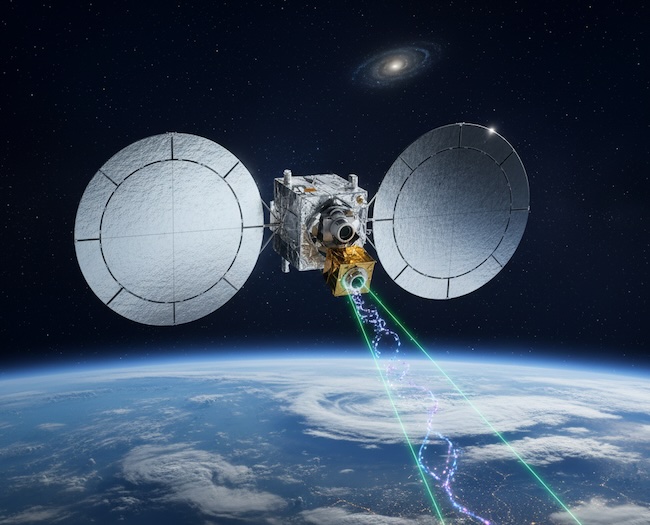
China's Micius Quantum Science Satellite is the world's first quantum enabled satellite. (Image by Gemini)
China has omitted electric vehicles from its list of strategic industries in its five-year development plan for 2026-2030, marking their first exclusion in more than a decade, as the sector grapples with oversupply challenges.
New energy vehicles (NEVs)— a category comprising EVs, plug-in hybrids, and fuel cell vehicles — were included as strategic emerging industries in the previous three five-year plans, aimed at sharpening industrial competitiveness.
The central and local governments had provided billions of dollars in subsidies, helping China achieve a leading position in the global EV market and industry chain.
PLAN SETS QUANTUM, BIO-MANUFACTURING, HYDROGEN AS PRIORITIES
However, the 15th five-year plan, published by the official Xinhua News Agency on Tuesday, prioritises quantum technology, bio-manufacturing, hydrogen energy, and nuclear fusion as new drivers of economic growth, omitting NEVs from the list.
Automobiles were mentioned alongside housing, with the government urging the removal of purchase restrictions to boost consumption.
The full five-year plan will be released at a parliamentary meeting in March.
China has over the years become the world's largest auto market. But the sector has been gripped by overcapacity, a prolonged price war and excessive competition.
In remarks on the new five-year plan published by Xinhua also on Tuesday, Chinese President Xi Jinping reiterated the importance of avoiding rushing to develop and invest in the same "new productive forces".
"We aim to guide all parties concerned to adopt a sound, rational, and realistic approach in their work and refrain from rushing headlong into new initiatives," Xi said.
Earlier this year, Xi questioned whether every province needed to develop industries such as artificial intelligence, computing power, and EVs, according to the People's Daily.
CHINA STRUGGLES WITH SATURATED DOMESTIC EV MARKET
Since China kicked off an EV push in 2009, a growing number of cities not traditionally known as mobility hubs, such as Hefei and Xi'an, have turned into EV heavyweights. The advances, in tandem with China's ambition to be a leading innovator, have almost every locality jostling for a place.
A saturated domestic market with dozens of EV brands vying for consumers' spend amid entrenched deflationary pressures is compounded by clouds hanging over car exports as China navigates trade tensions with the West.
China's Communist Party has issued five-year plans since 1953 to set economic and industrial priorities for the nation's development.
(Reporting by Beijing and Shanghai newsrooms; Editing by Conor Humphries)
© 2025 by Asian Media Group Inc.
Recent Articles
- Samurai Blue Sweep Aside Tunisia, Japan Fans Sweep Monterrey Stadium
- Lebanon Fighting Threatens Switzerland Negotiations
- Danone-Chobani Yoghurt Protein War Underscores GLP-1 Impact
- Italy's Meloni Tells Trump to Focus on His Own Popularity as Row Continues
- Trump Unveils Gifted Qatari 747 As Addition to Air Force One Fleet
- A Warm World Cup Welcome Endears the US to Fans
- China's May Refined Oil Exports Rose from April, Australia Received Agreed Volume
- New Bangladesh Premier to Seek Investments, Jobs in China, Malaysia
- Charles Schwab Working with Cboe to Enter Prediction Market
- Mexico's Love Affair with All Things Korean — Until Thursday's Kickoff