

Asian Night Markets' Ancient Roots and Surprising Modern Vitality
By J. J. Ghosh | 05 Jun, 2026
I went looking for why Asian night markets showed up at virtually every AAPI Heritage Month celebration in America — and ended up in 9th century China.
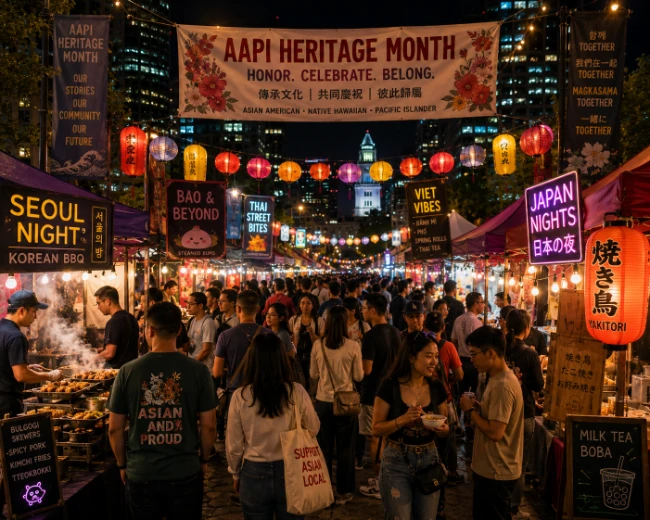
Asian American heritage month is officially over and I’m taking stock of what made May different from all other months.
First and foremost is of course the efforts toward inclusion that have been made by small businesses and corporations.
But I’m also looking at it through a less symbolic lens: What actual tangible efforts were made to celebrate our culture?
There were tons of heritage nights at baseball games which include not just special jerseys for fans and players alike but unique concessions for purchase. Libraries spotlighted books by AAPI authors and streamers highlighted AAPI-centric movies and shows.
And then there is what I would consider the most quintessential celebration of AAPI heritage:
The Asian night market.
The original night markets began outside of temples during the Tang Dynasty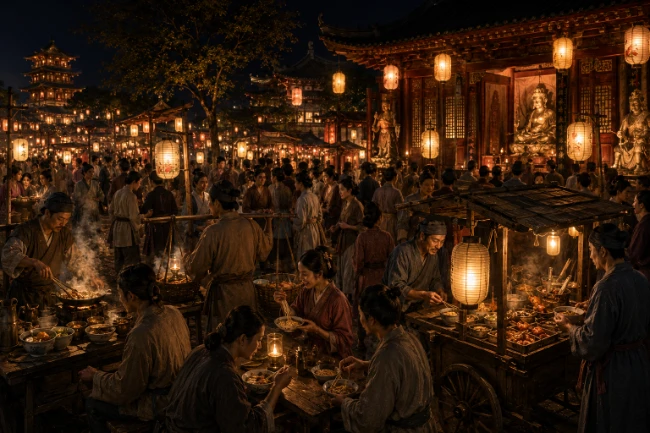
Night markets this past month felt so ubiquitous —held in nearly every major, midsized and even many small cities — that, frankly, not holding one during AAPI month almost felt like an intentional slight against our community.
I was fortunate enough to attend a few and at risk of sounding bougie, even checked out a traditional one in Bangkok during a vacation. But I never understood how and why the idea of a sprawling night market became viewed as the quintessential piece of Asian culture here in the United States.
So I decided to find out.
Fourteen Centuries of Street Food
The answer starts as many things in Asian history do: in Tang Dynasty China.
The first night markets sprouted up as early as the 9th century A.D. In short they were born from the intersection of religion, labor, and hunger.
The informal gatherings of peddlers relied on the draw of temples and the evening visitors who had been unable to come during working hours.
A modern day Asian night market in the US includes food stalls and entertainment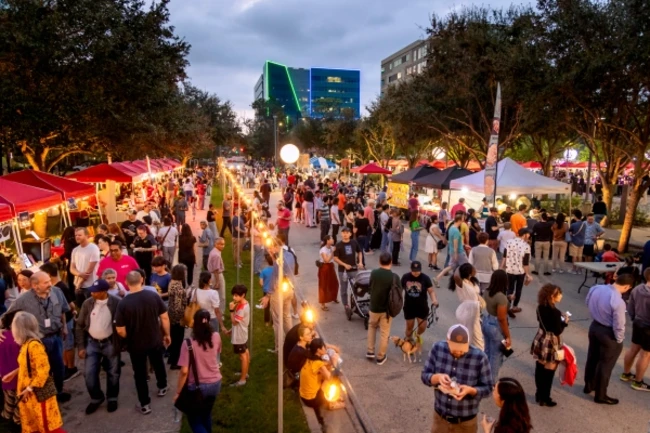
Merchants, many of whom couldn’t afford permanent stalls during the daytime, would swarm the area with pushcarts and shoulder poles.
The temple provided the foot traffic and the darkness provided a kind of democracy — rich and poor, merchant and laborer, jostling together under the same lanterns for the same bowl of noodles.
The Tang government, perhaps recognizing the disorder this represented, put strict sanctions on night markets and their operations in A.D. 836. The markets kept going anyway. This is also very much part of the tradition.
Scholars have noted that the temporality and makeshift nature of the markets reflects a long history of marginalization — the street vendor as someone operating outside the formal economy, setting up where permitted and packing down before the authorities notice. The night market was always, on some level, an act of informal economic resistance. It survived precisely because it needed nothing permanent.
No lease. No storefront. Just a cart, a fire, and something good to eat.
How It Traveled
Night market culture spread globally with overseas Chinese populations. Wherever Chinese immigrants went — Southeast Asia, Taiwan, the Philippines, Malaysia, Singapore, eventually Canada and the United States — the night market followed.
Taiwan became the night market's most celebrated home. The modern Taiwanese night market didn’t appear until post-World War II, in denser urban areas, when the unprecedented "Taiwan Economic Miracle" occurred while the island was transitioning from authoritarianism to democracy.
The economic changes brought in migrant workers who eventually made up a large base of customers in the 1950s and 1960s. As the night markets expanded and Taiwan grew, they expanded their business beyond food into toys, garments, accessories, handicrafts, Chinese medicine, and international goods — becoming in the modern era a one-stop community hub for eating, shopping, socializing, and simply being in public together.
Today Taiwan has over 70 night markets, with 30 of them just in Taipei. Shilin, the largest, has over 500 stalls.
And what began in Southeast Asia has more recently travelled to Canada and the West.
The American Version
But here’s what gets lost when the night market is transplanted to a Heritage Month celebration in an American city: it was never meant to be a celebration or even an event. It was meant to just be ordinary life.
In Taipei or Bangkok or Kuala Lumpur or Ho Chi Minh City, you go simply because you're hungry and it's evening and that's where everyone goes. The night market is the neighborhood pub, the corner diner, the community center, the place where grandmothers argue with vendors about the price of scallion pancakes and teenagers flirt over cups of pearl milk tea.
Night markets became a popular and common place for locals of each city to meet, hang out, socialize, and find something to eat. The cultural significance isn’t something layered on top. It’s the thing itself.
Which is why, when AAPI Americans reach for a way to celebrate their heritage, the night market is the instinctive answer. It doesn't feel like a cultural performance. It feels like home. Or at least like the closest approximation of home that a parking lot in downtown Houston can provide.
For the last two decades, cities across the United States have increasingly hosted night markets — typically expansive open-air community events featuring food, merchandise, and entertainment from local vendors and artists. Here, they’re most frequently held during Asian American Pacific Islander Heritage Month.
But it’s important to think of America’s version of the Asian night market as more of a translation than a replica.
The health codes are different. The parking situation is more complicated, and fewer grandmothers are haggling over prices. At least not successfully. But the essential structure — vendor stalls, street food, communal space, open air, evening hours — is preserved. And with it, something harder to name: the feeling of a culture being itself in public, without apology or explanation, in a way that daily American life rarely provides.
There’s also something specifically meaningful about the night market as an immigrant economic institution.
On the surface, these community events are art and food-centered celebrations of Asian culture. Underneath, they’re small business incubators — the same function the original Tang Dynasty markets served. The AAPI entrepreneur who can't afford a brick-and-mortar restaurant can afford a stall at a night market.
The home cook who spent decades feeding her family can hand her dumplings to a stranger and watch them understand, for the first time, what her kitchen has always tasted like. These street stalls have become an essential part of the local economy in Asia for exactly this reason — because they give economic access to people who would otherwise have none.
The American version is doing the same thing, just with permits and porta-potties.
Why It Works as a Celebration
Every culture has its gathering ritual. The Irish have the pub. The Italians have the piazza. The Jewish community has the deli. What these spaces share is a quality of unselfconsciousness — a place where the culture exists for its own sake, not for external consumption, and where belonging is assumed rather than performed.
The night market is that space for much of the AAPI world. And the reason it translates so naturally to AAPI Heritage Month in America is precisely because it doesn't require translation. You don't need to explain a night market to someone who grew up going to one. You don't need to perform anything. You just show up, find the stall with the longest line, and eat.
The fact that it originated in the 9th century and was technically illegal when it started is, frankly, only making it more compelling.
Some traditions earn their permanence. The night market has been earning it for fourteen hundred years.
Night markets this past month felt so ubiquitous —held in nearly every major, midsized and even many small cities — that, frankly, not holding one during AAPI month almost felt like an intentional slight against our community.
Recent Articles
- Your Answers to These 7 Questions Will Reveal Whether You're Sane or a Closet Lunatic
- US Oil Companies Profit from Strait of Hormuz Closure Says Russian Oil CEO
- Trump Faces New Republican Resistance in Congress as Midterms Approach
- SpaceX IPO Already Two Times Oversubscribed
- SpaceX Signs Google As AI Compute Client After Landing Anthropic
- $1 Trillion in Stock Market Valuation Erased by AI Chip Selloff
- Anthropic Urges Industry Pause As AI Nears Recursive Self-Development
- Trump's South Lawn UFC Birthday Bash to Mix Politics with Punches
- Trump Policies Targeting 39 Nationalities of Immigrants Invalidated
- One Man Holds Back the World's Progress toward Green Energy Sufficiency and Prosperity