

Asian Americans Lose Top Health Billing on New Data Granularity
By J. J. Ghosh | 06 May, 2026
Our assumption that we're America's healthiest ethnicity becomes unsettled as new data threads emerge.
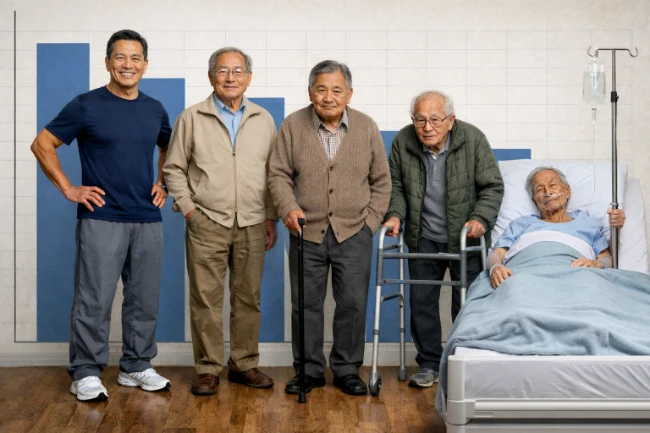
The model minority myth has always come with a health claim baked in:
Asian Americans are not just successful, we're also strong and resilient. We take care of ourselves and our elders. We don't complain, and we don't get sick.
In fact science has actually supported these claims.
Until now.
According to a new study published in the Journals of Gerontology older US-born Asian Americans are no longer the healthiest aging racial group in the country .
I’ll be honest: the competitive part of me wanted to know how we could regain the top spot.
But our health is of course about much more than a competition.
And this study's findings, it turns out, are much more nuanced than I could have imagined.
The "Healthy Immigrant" Effect

For the past two decades, older Asian Americans have been the healthiest demographic among elders in the US.
In the past, older Asian Americans had better health outcomes than other groups because the large majority were foreign-born.
People with poorer health and lower socioeconomic status were less likely to resettle in another country, so Asian immigrants became a "very positively selected" group that's healthier and more successful economically compared with both the source and the destination populations.
In other words, the data was always a little bit of a cheat. We weren't healthier because of anything inherent to our community. We were healthier partly because the immigration process itself filtered for people who were already in good shape — physically, financially, and otherwise. Sick people don't generally uproot their entire lives and move to a country where they don't speak the language.

Anti-AAPI bigotry has been a source of mental and therefore physical stress on Asian Americans
But that advantage doesn't transfer to the next generation. U.S.-born Asians were immediately exposed to the country's cultural and political realities — the same stressors, the same food environment, the same healthcare gaps, the same everything — without the selection effect that protected their parents and grandparents.
We are, in other words, becoming American. And apparently that's not great for your health.
The Financial Effect
The study points to income inequality as a significant driver of the trend. While income levels rose for most groups during the study period, the proportion of older Asian Americans living on low incomes increased.
This economic strain correlated with a rise in disability rates among low-income Asian Americans, a trend not observed in other racial groups.
This is where the model minority myth does its most direct damage.
The assumption that Asian Americans are universally prosperous — that we're all doctors and engineers and tech founders — makes the very real economic struggles of a significant portion of our community invisible. The poverty rate for AAPI adults aged 65 and above is 13%, while for other groups it is 9%.
Yes, Asian Americans have the highest median income of any group in the United States. We as a whole have significant spending power. But that fact doesn’t erase the existence of the lower class.
The Mental Health Effect
Here's something that doesn't show up cleanly in disability statistics but almost certainly contributes to them: AAPI adults are the racial group least likely to seek mental health services — three times less likely than their white counterparts.
Of AAPI adults with a mental illness, 73.1% did not receive treatment, compared to 56.7% of the overall population.
Why? The reasons are layered and cultural and deeply familiar to anyone who grew up in a household where mental health was simply not discussed.
Many AAPI are raised to conceal their emotions as a defense against the discrimination and racism they will face. This causes a fear of vulnerability and any perceived failure. Many are uncomfortable disclosing their mental health struggles, fearing they will disappoint family members and deviate from the model minority standard.
There's also the compounding stress of simply existing as an Asian American in this country right now. Discrimination and unfair treatment have been linked to major depressive disorders, clinical anxiety disorders, and mood disorders. Even mundane everyday microaggressions contribute to stress and cause wear and tear on the body.
Mental health is physical health. Chronic stress has physical consequences. Untreated anxiety and depression don't stay in your head — they end up in your joints, your cardiovascular system, and your immune function.
A community that has been taught for generations that asking for help is weakness, and that is simultaneously experiencing elevated levels of discrimination and xenophobia, is going to carry that weight somewhere.
The Research Effect
While we may not like hearing the results of this study, the researchers deserve credit for their thoroughness.
While most AAPI health research treats Asian Americans as a monolith, this study manages to capture our diversity. It notes that cognitive disability is more prevalent in Vietnamese, Filipino and Japanese older adults.
Vietnamese, Chinese, Filipino and Indian older adults on the other hand have higher prevalences of self-care disability.
These are not the same communities. They don't share the same immigration histories, the same economic trajectories, the same relationships to healthcare, or the same cultural frameworks around aging and disability.
The habit of lumping 50-plus ethnicities and as many languages into a single data category has always served the model minority myth more than it has served our actual community. It lets the success of one group mask the struggles of another. It lets policymakers point to aggregate AAPI outcomes and conclude that nothing needs to be done.
This study is, in part, a corrective to that. And the picture it reveals is less flattering — and more honest — than what we've been told.
The Takeaway
There's a version of this story that reads as alarming. Asian Americans are no longer the healthiest. We've been overtaken by white Americans. The advantage is gone.
I'd offer a different frame. The advantage was always partly a statistical artifact of who was allowed to immigrate, and it was always obscuring significant suffering within communities that didn't fit the model minority mold.
What this study is showing us isn't a collapse — it's a more accurate picture of where we actually are.
And where we actually are is a community that is aging, that is economically more stratified than the headlines suggest, that is carrying significant mental health burdens it has been taught not to acknowledge, and that is doing all of this in a political environment that has spent the last several years making us feel less welcome, less safe, and more like a punchline or a threat than like people who live here and are trying to stay healthy.
For years, society has been telling us that we’ve failed to fully assimilate to American culture. It turns out that we’re doing just fine in that regard.
And we have the declining health to show for it.
For years, society has been telling us that we’ve failed to fully assimilate to American culture. It turns out that we’re doing just fine in that regard.
Recent Articles
- Asian Stocks Hit Record High, Dollar Wobbles on Peace Hopes
- Latest Trump Peace Proposal to Iran Omits Key Terms in Bid for Quick Peace
- New York Judge Releases Purported Epstein Suicide Note
- My Favorite Asian Looks at the 2026 Met Gala
- Anthropic to Use SpaceX Data Center As Personality Clash Fades
- UCLA Med School Accused by DOJ of Favoring Black, Hispanic Applicants
- Weekly Sports Roundup: Clutch Plays from Suzuki and Hachimura, Ji KO’s Bully
- Top Quantum Computing Advances of April 2026
- Correspondents Dinner Shooter May Have Been Triggered by Iran
- Rivian Developing Variants of Affordable R2 EVs